Drowning in Recruiting Data? Here’s the Only 2 Types You Need
Most recruiting leaders have a problem with data.
The problem is that we have access to...sooo...much...freaking...data!
So, the question becomes, what’s relevant? What do I do with it? How do I get it in the right format? How do I create insightful visualizations? Who is going to help me?
Well, there's no easy answer to those questions BUT, I’ll offer up a way that I like to think about my data and maybe it’ll help you put together your strategy too.
I know I have a lot of fellow data nerds in my community here…would love to hear how you attack the problem of too much data in your functions???
FOCUS ON TWO TYPES OF DATA
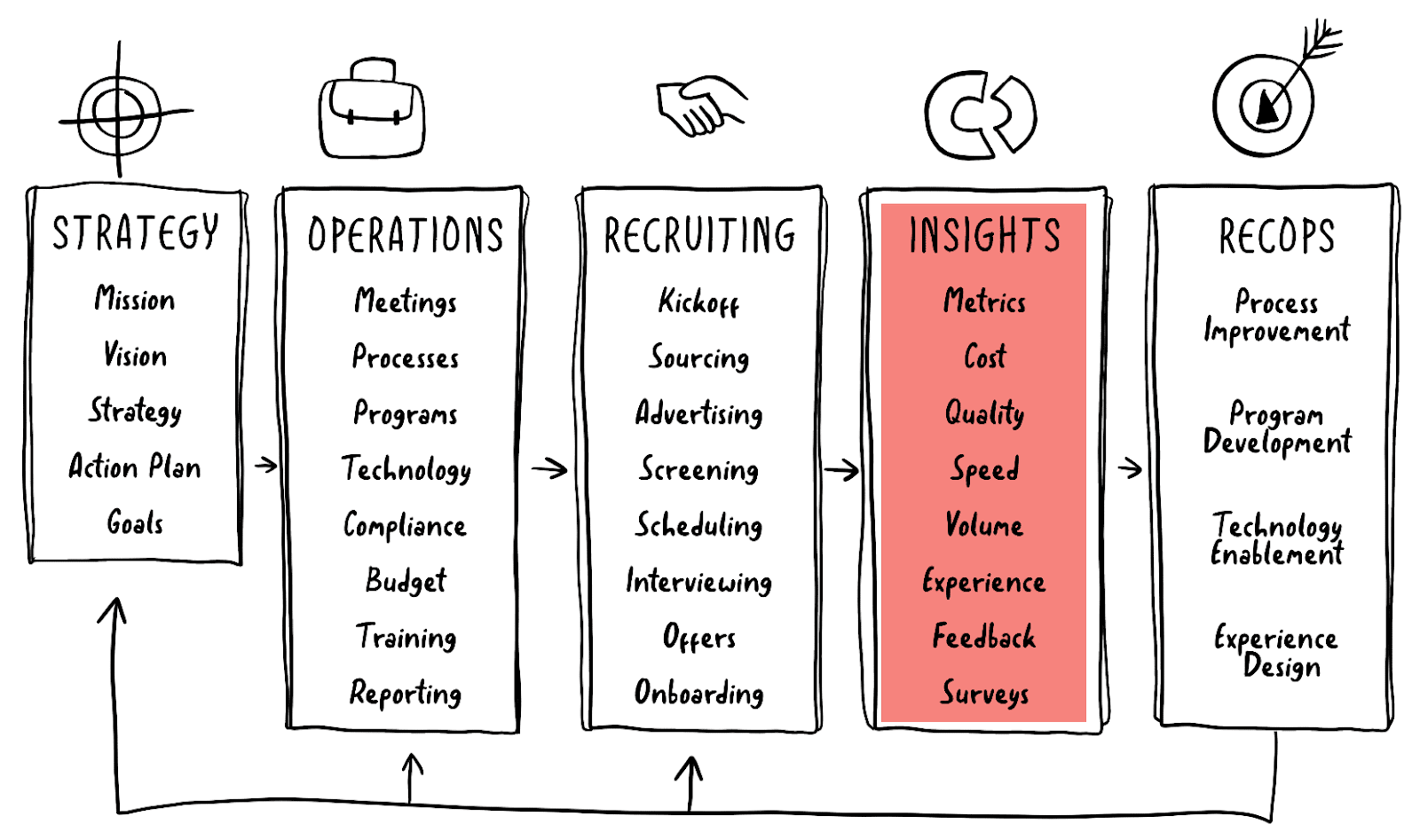
I’m going to refer back to the “Recruiting Operations Framework” I’ve shared in the past. It’s the operating system I use to build and manage all aspects of my talent acquisition function. It’s the central theme of my book.
If you peek at the pillars below, you’ll notice there’s an “Insights” pillar to the right of the “Recruiting” pillar because — as I've said before — the value in a TA function flows from left to right.
In this case, to uncover problems or drive performance in your recruiting function, you have to study the “exhaust” that your recruiting process kicks off. That exhaust could come in the form of data related to cost, quality, speed, volume, experience, or whatever a candidate or hiring manager wants to provide you with in the form of raw feedback.
So how do you start making sense of all your data and begin generating insights to improve your function?
Well, it's helpful to segment the reasons why you need this data in the first place.
Understanding the purpose of your data helps you prioritize what reports, dashboards, or deep-dives you're going to do first. I think of my data and insights as living in 2 buckets:
Operational
Diagnostic
Let's talk about each type.
OPERATIONAL DATA & INSIGHTS
I think of Operational data and insights as the window into the effectiveness of your day-to-day recruiting. It's data that you monitor regularly to identify when something has strayed from the norm. For example:
How many applications or interviews do I have for job XYZ?
How many referrals did we generate this month for our call center jobs?
How many jobs did we fill for Finance? What was the time-to-fill?
For operational data, you'll likely have a regular report or dashboard that is generated daily, weekly, or monthly. These are your most important reports and they probably ladder up to some metric you or your team is being held to.
DIAGNOSTIC DATA & INSIGHTS
Diagnostic data is typically an ad hoc process whereby you go looking for the answer to a one-off question. Usually, it's because you suspect something is going wrong or because a leader threw you under the bus for something with no data to back up their claim.
That never happens, right???
To that point, sometimes Diagnostic data can be used to show that something is going really well (despite what a leader said)!
Some examples...
How does the interview-to-hire ratio for Manager X compare to the rest of the company?
Why did our fall sales recruiting campaign fall short of its objectives?
Diagnostic data can also be forward-looking or proactively used when standing up a program, improving a process, or trying to make a better decision. For example:
Which city is most likely to result in the most applications for our Engineer posting?
Which colleges would be best to recruit MBA talent from?
Is there a performance correlation between managers who have a degree and those who don't?
One word of caution here…
Diagnostic data can be a time suck for not much value. So use your deep-dive time here wisely. They can be great for showing business value, but you might spend a month trying to get a single data point that gives you no insight at all.
METRICS
A lot has been written on the topic of metrics. And it's still not enough! So I won't go into detail on it here. But what I will say is that I think most recruiting organizations are doing metrics backwards.
They start by grabbing historical data or an industry standard metric for...let's just use...Time-To-Fill for example. And they say, well it should take us about 60 days to fill a software developer role. Or they say…it takes us 75 days and we want it to be 60 days. And that's what becomes the metric.
The way metrics should be done is by asking a single question:
What data point or points will tell us if our Talent Acquisition efforts are successful?
Maybe speed doesn't even matter. But let's say it does. Then, you ask the questions, "How fast does the business need us to hire Software Devs?" AND "How fast can my team reasonably find, schedule, interview, and process a Dev?"
From here, you reverse engineer all of the drivers that will get you to the number you agree upon with the Dev team.
Maybe that results in a project to do a persona and a micro EVP for the position to drive better applicants. Maybe you hire a name generation firm to speed up your lead list. Whatever it is, once you have the target, you can build the solution. But don't build a bunch of solutions first or go with a metric someone else is using. That usually limits your ability to think big and make real change.
Do this for all parts of your organization and you'll have recruiting metrics that your business loves and trusts.
MORE RESOURCES ON THIS TOPIC
I can only cover so much on data in a brief newsletter, so I thought I’d include the relevant chapter from my book on the topic of insights. It goes into more detail and provides some examples of how to work internally to get the reports you need. Here it is >> RecOps - Lioncrest Publishing - James Colino - Ch 5.pdf