Your talent acquisition model isn’t wrong…it’s just incomplete.
The truth is, no model you choose can solve all of your challenges.
In fact, I’m running 3 different models right now — centralized, decentralized, and outsourced.
I’m also filling gaps with plug-in services and technologies that automate different parts of the recruiting process.
It’s complicated, but so is our recruiting environment!
Twenty years ago, most companies either had a centralized team or decentralized processes. Today, there are so many fractional services, freelancers, outsourcing agencies, and technologies that you have no excuse for not having a TA function operating at peak performance.
But the challenge with that is threefold:
(1) Knowing which models and strategies exist and how they work.
(2) Choosing the best ones for your situation.
(3) Knowing how to knit them together to deliver results.
The model you choose determines how much you need to budget, how many people resources you require, what level of recruiter can operate in the model, and the complexity of your tech stack.
So, the model is the foundation from which all other decisions get made.
But what drives which model you choose?
Well, that’s usually determined by three factors also:
(1) How much does your company value talent acquisition.
(2) How much does your CHRO understand the value of talent acquisition.
(3) The experience and capability of the talent acquisition leader
Think about it. If a company operates on thin margins and doesn’t want to invest in a world class TA function, the CHRO doesn’t understand the difference between an ATS and a CRM, and the senior-most TA leader is a transplant from Finance…chances are you’re probably going to end up in a bare-bones recruiting department, probably fully outsourced.
For me, I’ve always sought out companies that understood the value of TA and were willing to fund my vision. In fact, I left a really great job when a new CHRO started talking about hiring an RPO.
Nothing against RPOs…that’s just not my jam.
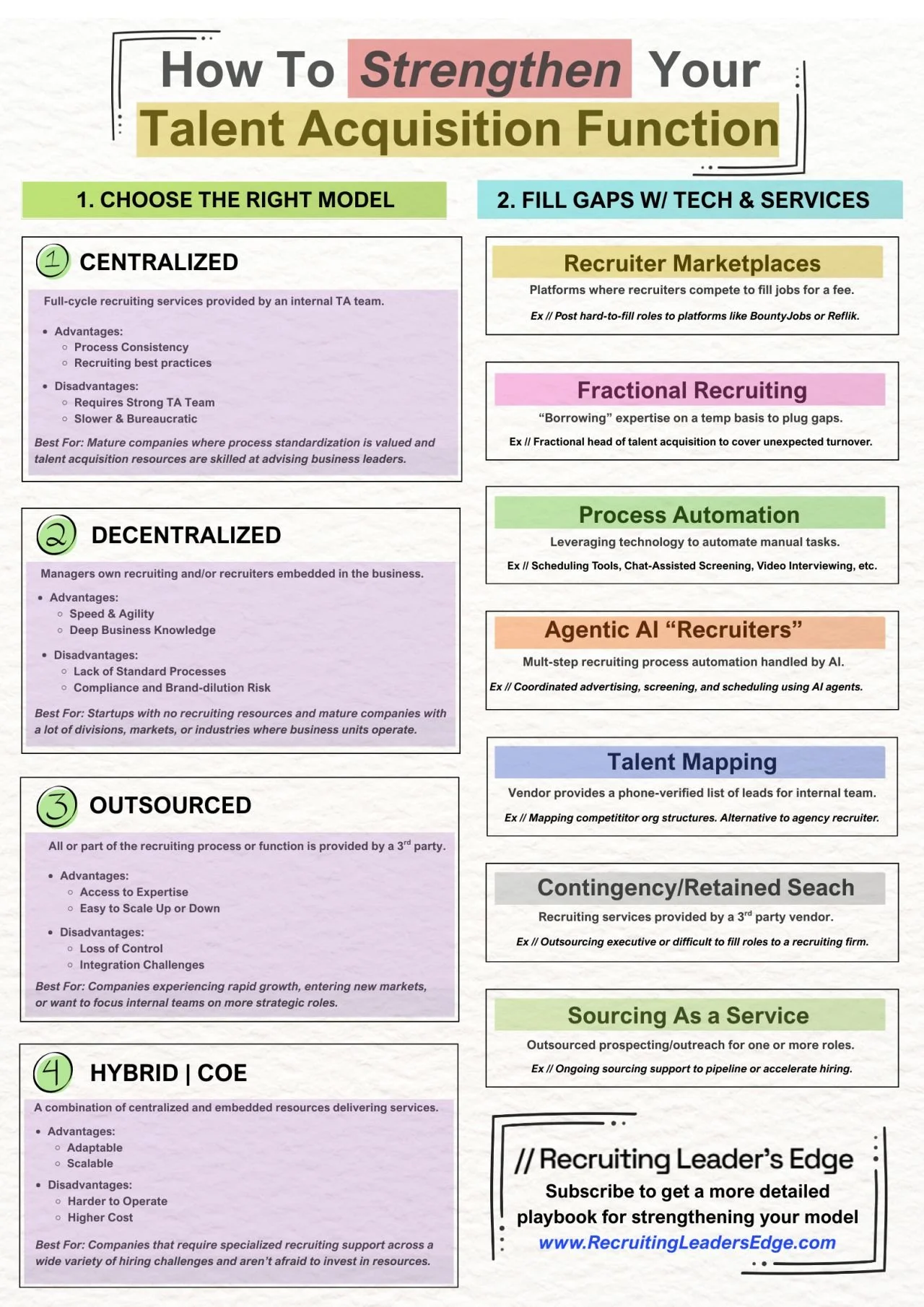
While it’s harder and more stressful for a leader to build an in-house or hybrid function like the one described in the image below, I wouldn’t have it any other way.
If you’re going to be a TA leader, the key to success is (1) choosing the right model for your business and (2) filling in your gaps with technology and services.
Fully commit to the profession and build something you can be proud of that gives your company a competitive advantage on talent.